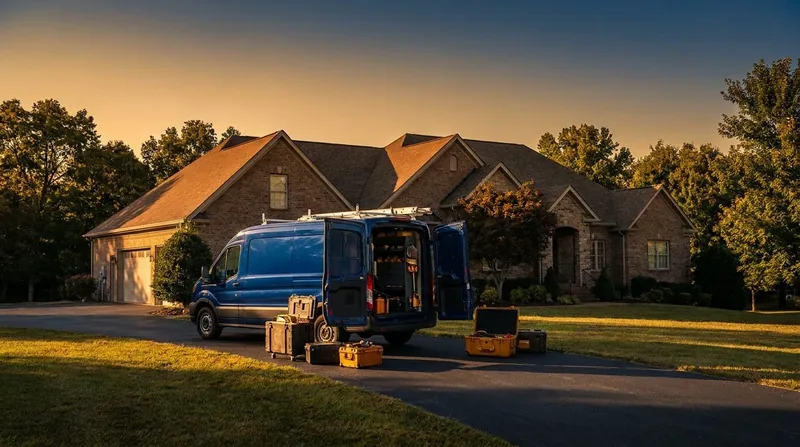
How to Get a Wisconsin Pest Control License and Start a Business
How to Get a Wisconsin Pest Control License and Start a Business
If you want to run a pest control company in Wisconsin, the paperwork is not one license. It is a short chain of separate credentials: a personal certification, an individual license to apply pesticides, a business license for each location, and a business entity registered with the Department of Financial Institutions (DFI). This guide walks through that chain in the order most applicants find easiest.
This article is informational content, not legal or tax advice. Pesticide rules, fees and forms change. Confirm current requirements with the Wisconsin Department of Agriculture, Trade and Consumer Protection (DATCP), DFI and the Wisconsin Department of Revenue (DOR). Talk with a qualified attorney about your entity choice and a CPA about your tax position before you file.
What a "Wisconsin pest control license" actually means
Wisconsin does not issue a single license called a pest control license or an exterminator license. Searches for "wisconsin exterminator license" and "wisconsin pesticide applicator license" lead to the same regulator, DATCP, which governs pesticide use under chapter ATCP 29 of the Wisconsin Administrative Code. The requirement has three parts:
- Certification: proof that you passed an exam in a pesticide category. For structural pest control, the category is Category 7.1 Structural Pest Control. Certification is valid for 5 years. This is what most people mean by "wisconsin pesticide applicator certification."
- Individual Commercial Applicator License: the license tied to you as a person who applies pesticides for hire.
- Pesticide Application Business License: the license tied to the business, with one required for each business location.
Wisconsin has no general business license at the state or county level, and most cities do not issue one either. A few do, so check with your municipal clerk. Your business still registers with DFI and, if applicable, DOR. Local zoning rules for storing or applying pesticides are handled by your city, village or town.
Materials and information to gather first
Collect these before you open any agency page. Missing one item is the most common reason applications stall.
- A proposed business name, checked in the DFI corporate records search at apps.dfi.wi.gov/apps/corpsearch/Search.aspx. A preliminary check is not final until DFI examines and files the document.
- A registered agent with a physical Wisconsin street address and an email address. The agent cannot be the company itself, and a P.O. box, mailbox service or answering service does not qualify.
- A federal Employer Identification Number (EIN) from the IRS, which you will need for tax registration and payroll.
- Government-issued photo ID and your home address.
- Current Category 7.1 study materials, which you should obtain from DATCP or its exam provider.
- A list of every location where you will store pesticides or operate from. Each one needs its own business license.
- A product list with a decision on bulk pesticides, because bulk purchasing raises the business license fee.
- An insurance quote and a copy of any insurance terms your commercial clients require. Ask DATCP whether any proof of insurance applies to your license, and confirm coverage with your insurer.
- An application record system, either paper or software, that can store service details for each job.
Step 1: Choose your business structure and file with DFI
Your structure determines what you file, what it costs and how your income is taxed. The two most common choices for a service company are the limited liability company (LLC) and the corporation.
LLC. File Articles of Organization, Limited Liability Company (Form 502) under section 183.0201 of the Wisconsin Statutes. The filing fee is $130. File online through DFI's Business Entity File Online system at dfi.wi.gov/Pages/BusinessServices/BusinessEntities/FileOnline.aspx. Online filings are in most cases accepted upon receipt, and DFI's statutory limit for processing new business filings is 5 business days. Your name must include "limited liability company" or "limited company," or the abbreviation "LLC" or "LC" (or a variation that differs only in capitalization or punctuation).
Corporation. File Articles of Incorporation, Stock, For-Profit Corporation (Form 2) under chapter 180 of the Wisconsin Statutes. The filing fee is $100.
Wisconsin taxes the two structures differently. By default, a multi-member LLC is treated as a partnership and a single-member LLC as a disregarded entity, so profits flow through to the owners' individual income tax at graduated rates of 3.50% to 7.65%. An LLC that elects corporate treatment pays the 7.9% corporate franchise or income tax. A corporation also pays the 7.9% rate. Wisconsin imposes no separate LLC franchise or privilege tax.
Both entity types require an annual report: a $25 fee each year after the year of organization or incorporation, due during the calendar quarter that contains your anniversary date. Organized January 1 to March 31 is due March 31. April 1 to June 30 is due June 30. July 1 to September 30 is due September 30. October 1 to December 31 is due December 31. A paper filing adds a $15 surcharge, bringing it to $40.
Two optional costs apply. A name reservation costs $15 and holds the name for 120 days (form CORP1 is at dfi.wi.gov/Documents/BusinessServices/BusinessEntities/Forms/CORP1.pdf). Expedited processing costs $100 on top of the filing fee. Neither is required.
Your registered agent must be on the formation document and every annual report, with an email address that DFI uses for official notices. Changing your agent or office costs $10 online or $25 on paper.
Step 2: Register a trade name if you will operate under a different name
If you will market the company under a name other than the one on your articles, such as "Lakeside Pest Solutions" for an LLC named differently, register it as a trade name with DFI's Trademarks and Trade Names Bureau. The fee is $15 per trade name, filed online or in person. DFI stopped accepting mailed trademark filings in March 2020. Renewal is also $15 and may be filed in the six months before expiration. Trade name registration is optional, and you do not need it to use a name, but it helps customers and banks connect the name to your entity. Fee details are at dfi.wi.gov/Pages/BusinessServices/Trademarks/Fees.aspx.
Step 3: Register for taxes with the Department of Revenue
Wisconsin issues no single general business license, but tax registration is effectively universal. Any seller of taxable products or services must hold a Seller's Permit, obtained through DOR's Business Tax Registration system at tap.revenue.wi.gov/BTR/. The permit costs $20 for an initial two-year period and $10 to renew each subsequent two years. The state sales tax rate is 5%.
Whether your pest control services or any products you sell are taxable is a question to confirm with DOR. Do not assume the answer from another trade. If you do need a permit, you can register DFI, DOR and Department of Workforce Development accounts in a single pass through the Wisconsin One Stop Business Portal at onestop.wi.gov. General DOR information for new businesses is at revenue.wi.gov/Pages/Businesses/New-Business-home.aspx.
Step 4: Pass the Category 7.1 Structural Pest Control exam
This is the step most people underestimate. You cannot apply the license until you hold the certification, and you cannot sign structural pest control customers until the license is issued. Plan the exam before you set a launch date.
Study the DATCP materials for Category 7.1 and take the exam under one of two options. The paper exam is free. The online exam, administered through Pearson VUE, costs $45. Confirm current scheduling, testing locations and retake rules with DATCP before you pay for anything. Certification is valid for 5 years, after which you will need to meet the agency's recertification requirements, which you should confirm with DATCP when the time comes.
Step 5: Apply for the Individual Commercial Applicator License
Once you hold the Category 7.1 certification, apply for the Individual Commercial Applicator License. The fee is $40 plus a $10 surcharge, for a total of $50. The license is valid January 1 to December 31, so it runs on a calendar year, not from your application date. Confirm with DATCP whether a license issued late in the year covers the rest of that year, and how the annual renewal is processed.
This license belongs to the individual who applies pesticides for hire. If you plan to hire technicians who will apply pesticides, confirm with DATCP which employees need their own certification and license before they go on a job.
Step 6: Obtain a Pesticide Application Business License for each location
The Pesticide Application Business License is tied to the business and each of its locations. The fee is $80 per location, or $92.50 if you buy bulk pesticides. If you add a second office, a storage facility or a satellite location, each one needs its own business license. Make the bulk decision before you apply, because it changes the cost of each license.
Step 7: Check local rules before you buy a truck or a storage shed
Wisconsin cities, villages and towns add their own zoning and licensing requirements, and these vary widely. Ask the municipal clerk whether you need a local license, whether home-based storage of pesticides is allowed in a residential zone, and whether the fire department or building inspector has rules for storing chemicals. Many applicants find that a local zoning question delays their launch more than any state form.
Step 8: Set up insurance, contracts and records before your first job
Most commercial clients and property managers will ask for a certificate of liability insurance before they hire you. Get quotes that address general liability and any pesticide-related coverage your insurer offers. Ask whether the policy requires you to be licensed before coverage starts.
DATCP's ATCP 29 rules also set requirements for application records and for notifying customers about pesticide applications. The rules address what information must be recorded, how customers are informed, and how long records must be kept. Those specifics are detailed, so set up a written process now and confirm the exact content, timing and retention periods with DATCP. Recordkeeping errors are a common source of enforcement problems, so build the process before your first application, not after your first complaint.
What the fees add up to
The table below lists the state fees for a typical LLC with one location. Your total depends on how you take the exam, whether you need a seller's permit and whether you register a trade name.
| Item | Agency | Cost | Timing |
|---|---|---|---|
| LLC Articles of Organization (Form 502) | DFI | $130 | Filed once; online usually accepted on receipt |
| Name reservation (optional) | DFI | $15 | Holds name for 120 days |
| Category 7.1 exam | DATCP / Pearson VUE | Free (paper) or $45 (online) | Certification valid 5 years |
| Individual Commercial Applicator License | DATCP | $40 plus $10 surcharge ($50) | Valid January 1 to December 31 |
| Pesticide Application Business License | DATCP | $80, or $92.50 with bulk pesticides | Required for each business location |
| Seller's Permit (if required) | DOR | $20 initial, $10 renewal | Two-year period |
| Trade name (optional) | DFI | $15, renewal $15 | Renewal filed in six months before expiration |
| LLC annual report | DFI | $25 ($40 by paper) | Quarterly due date based on organization date |
For a single-location LLC with no bulk pesticides, the core state costs are $260 for the LLC filing, the individual license and the business license, using a paper exam. Adding an online exam ($45), a seller's permit ($20) and a trade name ($15) brings the total to $340. These figures exclude insurance, vehicles, equipment, pesticide purchases and any local fees.
Common mistakes to avoid
- Searching for the wrong license. There is no statewide "exterminator license." Apply through DATCP for certification and applicator licensing, and through DFI for the entity.
- Selling service before the individual license issues. Signing customers and scheduling applications before you hold the license exposes you to enforcement and insurance problems.
- Forgetting the per-location business license. A second storage site or office needs its own $80 or $92.50 license.
- Using a P.O. box as the registered office. DFI requires a physical Wisconsin street address for the registered agent.
- Letting the annual report slip. The $25 annual report is due by the quarter containing your anniversary. Missing it can put your good standing at risk.
- Choosing bulk pesticides without running the numbers. The bulk business license is $12.50 more per location. That is worth it only if your purchasing volume justifies it.
- Choosing a name that is too close to an existing entity. DFI requires names to be distinguishable on its records. Run the search before you pay.
- Skipping the customer notice and record process. ATCP 29 sets requirements for both. Build them in from day one.
Ongoing deadlines to calendar
- LLC or corporation annual report: $25 each year, due by the quarter containing your anniversary date.
- Individual Commercial Applicator License: valid through December 31 each year. Renew before the calendar year ends.
- Pesticide Application Business License: one per location. Confirm the renewal schedule with DATCP.
- Category 7.1 certification: valid 5 years. Confirm the recertification process well before the expiration date.
- Seller's Permit: $10 renewal every two years, if you hold one.
- Trade name: $15 renewal, filed in the six months before expiration, if you registered one.
What you can expect once the paperwork is complete
Working through these steps in order is designed to leave you with a registered entity, the correct DATCP credentials for structural pest control, a business license for each location, and a process for records and customer notices. Those pieces may help you operate on the right side of Wisconsin rules and give commercial clients the documentation they ask for. Licensing does not guarantee customers, pricing power or profitability. Those depend on your service area, pricing, marketing and reliability.
When the filings are done, verify each license with the agency before you advertise. Keep a folder with your DFI confirmation, your certification, your license copies and your insurance certificate. If your structure, tax position, or local zoning is complicated, speak with a qualified attorney or CPA before you sign a lease or elect a tax treatment. A short consultation now is far cheaper than unwinding a filing later.
Keep exploring: related Wisconsin guides
- How to Start a Lawn Care Business in Wisconsin
- How to Start a Cleaning Business in Wisconsin
- How to Start a Landscaping Business in Wisconsin
- How to Start a Junk Removal Business in Wisconsin
- Wisconsin Contractor License
- How to Start an LLC in Wisconsin
- Wisconsin Business License
- How Much Does It Cost to Start a Business in Wisconsin
- All Wisconsin business types
- Every Wisconsin guide in one place