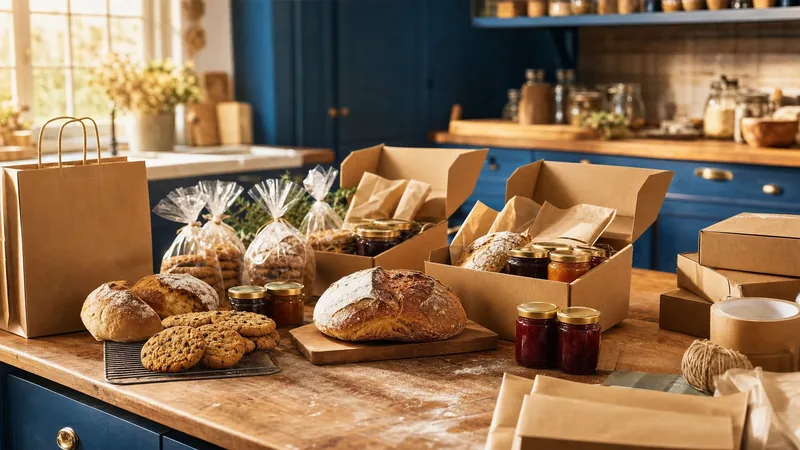
Wisconsin Cottage Food Law: Selling Home-Baked Goods Without a License
Wisconsin Cottage Food Law: Selling Home-Baked Goods Without a License
If you bake cookies, breads, muffins, or cakes at home, you may be able to sell them directly to customers without a food license. Wisconsin has no cottage food statute for baked goods. The protection comes from a court decision, and a few conditions decide whether your products qualify. This guide explains what the Wisconsin cottage food law allows as of October 2026, what you still need to register, and where home bakers usually go wrong.
This is informational content, not legal or tax advice. Talk with a qualified attorney or CPA if your situation is complex, and confirm current rules with the agencies named below before you sell.
What the Wisconsin Cottage Food Law Actually Allows
Wisconsin's home baking rule comes from Kivirist v. DATCP, a Lafayette County case decided in 2017. The court allowed home bakers to sell shelf-stable baked goods directly to consumers with no license and no sales cap. The protection was extended to flourless baked goods in 2021.
Three points define the current rule:
- Shelf-stable baked goods qualify. Cookies, breads, muffins, and cakes that do not need refrigeration fall within the protection.
- Unbaked goods do not qualify. Candy, fudge, and granola are not allowed. The Court of Appeals reversed the injunction in this case on November 19, 2024, and the Wisconsin Supreme Court denied review in April 2025.
- There is no sales cap for baked goods under the court ruling, as of the date of this article.
The phrase "wisconsin cottage food license" is a common search, but no such license exists for home-baked goods. You are not applying for a home bakery license. You are operating under a court-recognized exemption, and you still have to register your business and tax status like any other seller.
The Pickle Bill Is a Separate, Narrower Rule
Many people searching for a Wisconsin canned goods law are really looking for the Pickle Bill. 2009 Act 101 lets home-canned acidified foods, such as pickles, be sold at events and farmers markets. Sales are limited to less than $5,000 per year. The Pickle Bill does not cover baked goods, and it is not a general permit for home food sales. If you want to sell both baked goods and home-canned pickles, treat them as two separate sets of rules and confirm each with DATCP.
Sales Cap Bills: Where Things Stand in 2026
Lawmakers introduced AB 748 and SB 739 in the 2025-26 session. Both would have set home food sales caps in two tiers, $10,000 and $40,000. Neither bill passed before the session's floor period ended in 2026. For a 2026 Wisconsin cottage food law check, that means the court-based rule for baked goods has no cap, and any cap discussion is about a possible future change. Check the status of any new bill before you scale up, because a future session could change the numbers.
Materials and Information You Need Before You Start
- A recipe you can reproduce exactly, with a written ingredient list and weights for every component
- A kitchen scale and measuring tools you use for every batch
- Food-safe packaging that keeps each product sealed and protected
- Printed labels with the product name, ingredients, and your business name and contact information
- A batch log, paper or spreadsheet, recording dates, ingredients, and batch numbers
- The identification details the Department of Revenue asks for during seller's permit registration
- A business name decision. If you sell under a name other than your own, plan on a trade name registration
- A computer and internet access for online registration with DFI and the Department of Revenue
Step-by-Step: Selling Baked Goods From Home in Wisconsin
Step 1: Confirm Each Product Is Shelf-Stable Baked Goods
Make a list of every product you plan to sell and sort it into two groups: baked goods that are shelf-stable, and everything else. Cookies, biscotti, quick breads, and most cakes generally belong in the first group. Items that need refrigeration, such as cream cheese frosting, custard, or cream-filled pastries, fall outside the shelf-stable test that the court protected. Candy, fudge, and granola are not covered at all. If a product sits in a gray area, ask DATCP before you list it for sale.
Step 2: Choose Your Business Structure and Name
Many home bakers start as a sole proprietor, which requires no state filing to begin operating under your own name. If you want to use a different name, such as Maple Street Cookie Co., you may register it as a trade name with the Wisconsin Department of Financial Institutions (DFI). The fee is $15 per trade name or trademark, filed online or in person at DFI. Registration is optional, but it documents the name you are using. Mailed trademark filings are no longer accepted.
If you form an LLC instead, the Articles of Organization (Form 502) carry a $130 filing fee. The LLC must keep a Wisconsin registered agent with a physical street address, not a P.O. Box. Each year it must file a $25 annual report during the quarter that contains its anniversary date, or $40 if filed by paper. Wisconsin imposes no separate LLC franchise or privilege tax, but profits flow through to your individual Wisconsin income tax return. Confirm the structure choice with a CPA.
Step 3: Register for a Seller's Permit With the Department of Revenue
Any seller of taxable products or services must hold a seller's permit from the Wisconsin Department of Revenue (DOR). The initial permit costs $20 for a two-year period, and renewal costs $10 every two years. You can register through the Wisconsin One Stop Business Portal at onestop.wi.gov, which registers your business with DFI, DOR, and the Department of Workforce Development in one pass, or directly through DOR's Business Tax Registration system.
Whether your baked goods are taxable is a question for DOR, not a settled answer you can assume. If they are taxable, you must collect and remit the 5% state sales tax plus any county or city sales tax where the sale takes place (0.5% in most counties). Ask DOR directly whether your specific products are taxable before you set prices.
Step 4: Check Local Rules Before You Sell
Wisconsin issues no general business license at the state or county level, and most cities do not require one either. A few cities, such as Lake Geneva, do license businesses, so the answer depends on where you live. Call your municipal clerk and ask whether the city requires a business license or home occupation permit. Check your zoning rules and your lease or homeowner's association agreement too, since those can restrict selling from a home even when state law allows it.
Step 5: Label Every Package Correctly
Every package should show the product name, a full ingredient list, and your business name and contact information. Packaged foods sold under federal rules also generally need a net weight statement and allergen information. Because labeling requirements depend on the product and the sales channel, confirm the full label checklist with DATCP and the FDA before you print your first run.
Step 6: Sell Direct and Confirm Any Other Channel
The court protection is for direct sales from you to the consumer. Selling to a coffee shop, grocery store, or other reseller is a different situation, so check with DATCP before you wholesale anything. Farmers markets and events may ask for your seller's permit, proof of local approval, or other paperwork, so contact the market manager before you apply for a stall. Shipping baked goods to customers is also a separate question that you should confirm before you offer it.
Step 7: Keep Records From Day One
Keep a batch log for each recipe, with the date, ingredients, and batch number, so you can trace any problem back to its source. Keep sales records that show what you sold, when, and for how much. Your seller's permit renewal, LLC annual report, and any trade name renewal each have their own deadlines, so put them on a calendar when you register. A trade name renewal may be filed in the six months before it expires, for $15.
What You Can and Cannot Sell Under the Current Rules
| Product | Status under the Kivirist ruling | What to do |
|---|---|---|
| Cookies, bread, muffins, cakes (shelf-stable) | Generally covered for direct sales to consumers | Register, label, and keep records |
| Flourless shelf-stable baked goods | Covered, as extended in 2021 | Confirm your recipe qualifies |
| Cream-filled or refrigerated baked goods | Outside the shelf-stable test | Ask DATCP before selling |
| Candy and fudge | Not allowed | Do not sell under this rule |
| Granola | Not allowed | Do not sell under this rule |
| Home-canned pickles and acidified foods | Pickle Bill applies, under $5,000 per year | Sell only at events and farmers markets |
Common Mistakes to Avoid
- Looking for a home bakery license. Wisconsin does not issue one for this activity. Skipping the seller's permit because you think no license is needed is a common and costly error.
- Selling unbaked goods. Fudge, candy, and granola fell outside the protection after the November 19, 2024 Court of Appeals decision.
- Assuming a cap exists or does not exist. The 2025-26 cap bills did not pass, so there is no cap today, but that is a point to recheck each session.
- Ignoring whether items are taxable. Ask DOR before you assume your products are exempt or taxable.
- Using a name without registering it. Operating under a trade name you have not registered can create confusion with DFI records.
- Forgetting local rules. A state exemption does not override a city ordinance, a zoning restriction, or a lease.
- Missing the LLC annual report. The $25 report is due during the quarter that contains your anniversary date, and late or missed filings create avoidable problems.
Tips From Experienced Home Bakers
- Start with two or three products you can make consistently, then add more once your labels and records are in order.
- Call DATCP before you launch any product that is not plain shelf-stable baking, and write down the name of the person you spoke with.
- Ask the Wisconsin Small Business Development Center Network at wisconsinsbdc.org to review your plan with an advisor.
- Pay for a one-time consultation with an attorney if you plan to sell at multiple markets, wholesale, or ship nationally.
Frequently Asked Questions
Do I need a license to sell cookies from home in Wisconsin?
Shelf-stable cookies sold directly to consumers fall within the court-recognized protection, so no food license is required under that ruling. You still need a seller's permit if your sales are taxable, and you should check local rules with your city.
Is there a sales cap for home baked goods in Wisconsin?
Not for baked goods under the Kivirist ruling as of October 13, 2026. The AB 748 and SB 739 cap bills did not pass. The Pickle Bill, which covers home-canned acidified foods, does have a $5,000 per year limit.
Does Wisconsin have a canned goods law for home sellers?
Yes, the Pickle Bill (2009 Act 101) allows home-canned acidified foods to be sold at events and farmers markets, with sales under $5,000 per year. It does not cover baked goods.
Where to Confirm the Rules
- Wisconsin Department of Financial Institutions, business entities and trade names: https://dfi.wi.gov/Pages/BusinessServices/BusinessEntities/GeneralInformation.aspx
- DFI business entity search: https://apps.dfi.wi.gov/apps/corpsearch/Search.aspx
- Wisconsin Department of Revenue, new business information: https://www.revenue.wi.gov/Pages/Businesses/New-Business-home.aspx
- Wisconsin One Stop Business Portal: https://onestop.wi.gov
- Wisconsin Department of Agriculture, Trade and Consumer Protection (DATCP): search the agency website for food processing and home food sales guidance
- Wisconsin Small Business Development Center Network: https://wisconsinsbdc.org/
- U.S. Small Business Administration, Wisconsin district: https://www.sba.gov/district/wisconsin
Wisconsin's home baking rules are useful for small sellers, but they are narrow and they change. Confirm each product, each sales channel, and each registration before you sell, and keep your records clean from the first batch.
Keep exploring: related Wisconsin guides
- How to Start a Coffee Shop Business in Wisconsin
- How to Start a Food Truck in Wisconsin
- How to Become a Licensed Cheesemaker and Start a Cheese Business in Wisconsin
- How to Start a Winery or Distillery in Wisconsin
- Wisconsin Liquor License
- How to Start an LLC in Wisconsin
- Wisconsin Business License
- How Much Does It Cost to Start a Business in Wisconsin
- All Wisconsin business types
- Every Wisconsin guide in one place